Is Your Business Ready?
As we head into the 2026 peak season, BLLHA is working with our partners to prepare for and practice all-hazards scenarios across the destination.
Wildfire remains top of mind, but preparedness is bigger than one event. It’s about making sure our businesses, teams, and making sure our businesses, teams, and community are ready for whatever comes our way.
Strong operators don’t wait for an emergency to test their plans. Now is the time to pause, review your protocols, connect with your teams, and make sure your structure is ready to respond.
In this post, you’ll find practical resources to help you stay informed, strengthen your emergency plans, and engage with the Town of Banff and Parks Canada as they advance preparedness efforts across the region.
Tabletop Exercise: Emergency Preparedness for BLLHA Members
This March, BLLHA members will have two opportunities to attend an emergency preparedness tabletop exercise facilitated by Amanda Sobierajski, Information Engagement Specialist with the Alberta Emergency Management Agency.
As emergencies and disasters become more frequent, it is essential for individuals and their communities to be prepared – at home and at work. This participatory scenario-based session is designed to empower you with knowledge, tools and insights to ensure you’re prepared for whatever may come your way. Through a blend of storytelling, facts and practical tips, we’ll explore potential hazards and risks while providing supports, strategies and resources. We hope you leave the session feeling empowered to champion preparedness in your home, workplace and community – building resilience ahead of tough times.
Dates:*
March 10, 2026, Moose Hotel & Suites
March 19, 2026, Banff Park Lodge
*Both sessions are identical; please register for whichever date works best for you.
Time:
8:30 a.m. Check-in and Breakfast
9:00-11:00 a.m. Tabletop Exercise
Free of charge for BLLHA members.
BaseCamp: Are you connected?
In a real-time emergency, clear communication matters.
BLLHA represents the commercial sector within the Emergency Coordination Centre, acting as a direct liaison between lead agencies and our members. When critical information is shared, we move it quickly and clearly to operators across the destination.
Basecamp is our primary tool for real-time updates and resource sharing. It allows us to communicate at scale, house key documents, and ensure members have access to what they need, when they need it.
What's Inside BaseCamp?
✔ Emergency Planning resources from the Town of Banff
✔ Emergency response plan templates you can adapt for your own operation
✔ Industry emergency management planning tools and guidance
✔ Evacuation resources, including multicultural and multilingual considerations
✔ Cybersecurity hazard information and business continuity considerations
✔ Risk assessment and insurance resources
✔ Materials from previous presentations and workshops
✔ Case study content from the Jasper Wildfire Complex, including frontline FAQs and industry communications

Workforce Multilingual & Multicultural Considerations
In the Bow Valley, one in four residents was born outside Canada. Our emergency plans need to reflect that.
Preparedness only works if every member of your team understands the plan and their role within it.
With trusted partners, BLLHA developed a Workplace Inclusion Charter, a key consideration, and a practical checklist that integrates multilingual and multicultural awareness into onboarding, training, and personal emergency preparedness.
Inclusive plans are stronger plans.
Clarity Before Crisis
Insurance coverage and business continuity planning made a significant difference for operators impacted by the Jasper wildfire.
If you haven’t reviewed your policy recently, now is the time. Connect with your provider to clearly understand your coverage, business interruption terms, and any gaps that could affect your operation in the event of a disaster.
The Insurance Bureau of Canada offers practical resources to help you:
In June 2024, BLLHA hosted Craig Stewart, VP of Climate Change and Federal Issues at the Insurance Bureau of Canada, who spoke to the growing national and global trend of increasing natural disasters and what that means for business preparedness.
Clarity now prevents confusion later.
FireSmart: Small Actions, Big Impact
Wildfires don’t just spread through flames, airborne embers can travel ahead of a fire and land on roofs, decks, and vegetation close to your structure. That’s why FireSmarting your property matters.
Banff’s unique geography, a resort community surrounded by forest and interface development, places us at elevated wildfire risk, particularly during dry summer months. With longer and more intense wildfire seasons driven by climate change, preparedness is no longer optional.
FireSmart practices help reduce the likelihood that your building will ignite during a wildfire. Simple actions like clearing debris, managing vegetation near structures, and maintaining roofs and gutters can make a meaningful difference.
Preparedness is a shared responsibility. Review the FireSmart Begins at Home Guide and take practical steps now to strengthen your property and protect the destination.
FireSmart is a national program designed to help property owners reduce the risk of wildfire damage. Simple, proactive steps around your building can make a meaningful difference in protecting your structure, your neighbours, and the broader Banff community.
Banff's Wildfire Reality
Banff’s natural setting is what makes this place extraordinary, and it also places us at elevated wildfire risk. As a resort community surrounded by forest and interface development, conditions can shift quickly during the dry summer months. With climate change extending wildfire seasons across Canada, this is simply the environment in which we operate.
Preparedness is a shared responsibility. Every operator and resident plays a role in understanding risk and taking practical steps to reduce it.
Through Banff National Park’s fire management program, Parks Canada is actively working to build more wildfire-resilient landscapes in the face of climate change. This includes ongoing risk-reduction and mitigation projects designed to better protect our communities.
Strong preparation at every level protects the destination.
Register for Voyent Alert
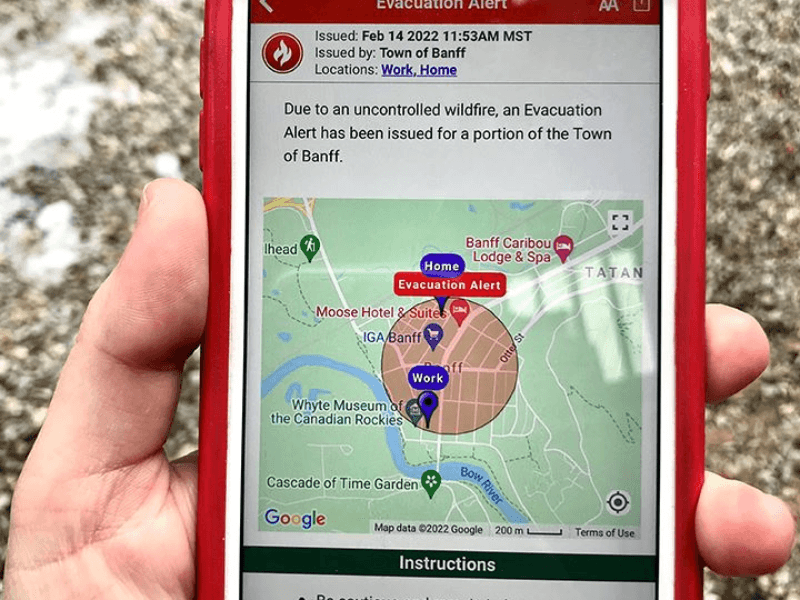
The Town of Banff provides emergency alerts using the Voyent Alert system to help residents and visitors become informed about situations that may require people to take action to protect their safety. These alerts may be town-wide or very localized to people who have placed their pins in a particular area, such as school, home or work location.
Incident Command System 100
ICS is a pan-Canadian command and control structure used to help manage emergency incidents and planned events. It provides the framework for standard incident management response and improves interoperability between all response organizations. This is the system used by all members of the Bow Valley Interagency Wildfire Committee.
Understanding the system and terminology increases understanding and confidence in jurisdictions and our local Agency’s response.
Public Safety Power Shutoff (PSPS)
BLLHA has worked with AltaLink and FortisAlberta to better understand the proposed Public Safety Power Shutoff (PSPS) program and its potential implications for the Bow Valley hospitality sector. Based on information provided by both utilities, a PSPS would only be considered as a last-resort wildfire mitigation measure under rare, extreme conditions. Historical data indicates the trigger conditions have not occurred in the Bow Valley over the past decade, although future decisions would be based on real-time weather and wildfire risk rather than historical trends.
To support member awareness and preparedness, BLLHA has developed an FAQ document summarizing responses from both utilities, including how PSPS decisions are made, what mitigation measures are being implemented to reduce the likelihood of outages, and best practices for business continuity planning.
Connect with BLLHA
BLLHA is here to support our members. Proactive preparation, grounded in an all-hazards approach, strengthens the commercial sector and helps our businesses navigate future challenges with greater confidence and stability.
We are actively monitoring the evolving preparedness landscape, including insurance considerations and the upcoming wildfire season. As new information becomes available, updates and resources will be shared through Basecamp.
If you have questions about emergency preparedness or need support accessing resources, reach out. We also welcome your feedback and ideas.
Preparedness is stronger when it’s shaped by the operators on the ground.